

Two-piece smell-ing suit custom-tailored in Yogyakarta
Essay publication Nero Editions: ‘Where Words Wane: Smell, Memory and Ros’ Uprooting’
Hand screenprinted fabrics by Pangestumu with phrases from essay
Audio work in collaboration with Sean Hayward and Roni Driyastoto
Abstinence performance with worn T-shirt, participatory performance, archive with worn T-shirts, collective textile work (growing)
Duration abstinene performance Lisette Ros: 172:00:00 hours
Duration participatory performance: 24:00:00 hours
2024-current
—
‘My Self, the (Unfamiliar) Roots’ (2023-current) explores how diasporic, cultural roots can be felt, embodied, and imagined through the body and the senses, particularly in relation to identity formation across generations. The project unfolds through multiple embodiments, each approaching heritage and identity from a different sensory perspective.
The second embodiment, (the Act of) Smell-ing, focuses on scent and the sense of smell as powerful carriers of memory and intergenerational transmission. Smell has the unique ability to evoke traces of personal and collective history directly, beyond language and rational frameworks.
ABSTINENCE PERFORMANCE
During her artistic research in Indonesia, Lisette Ros discovered how deeply scent connects to ancestral memory. In 2024, while in Bandung, she began an intensive exploration of her own “odor print”—the unique biological scent each person carries.
By eliminating artificial fragrances from her daily life, she encountered a confronting realization: she had likely never consciously experienced her own odor print before.
This led to a 172-hours long abstinence performance experiment on the land of her ancestors, in which she refrained from showering or bathing; wearing washed clothes; using perfumes, deodorants, or scented products.
She wore a basic, white T-shirt, same underwear and her tailored suit day and night for that week of length. The process allowed her natural odor to slightly resurface on the land Java, Indonesia as a form of embodied memory.


PARTICIPATORY PERFORMANCE
During her residency at Galeri Lorong in Yogyakarta in 2025, the personal abstinence performance experiment expanded into a participatory performance work.
A group of participants from different parts of Indonesia each received a new white T-shirt and were invited to:
• Wear the shirt continuously for at least 24-hours straight (daily life activities including during sleep);
• Refrain from washing;
• Avoid artificial scents such as perfume, deodorant, skin- haircare or other scented detergents.
After 24+ hours, the worn garments —now carrying hints of the participants’ personal odor— are collected and archived by artist Lisette Ros, and take place in the representation of this research and performance art work.
This work and abstinence performance continue to take place up until now, in the Netherlands and Indonesia; involving participants from Indonesia and from the Dutch-Indo, Indo-Dutch, Moluccan communities in both countries.
These textiles become both material and archive, marking the beginning of an alternative archive based not on images or texts, but on lived bodily presence and scent.


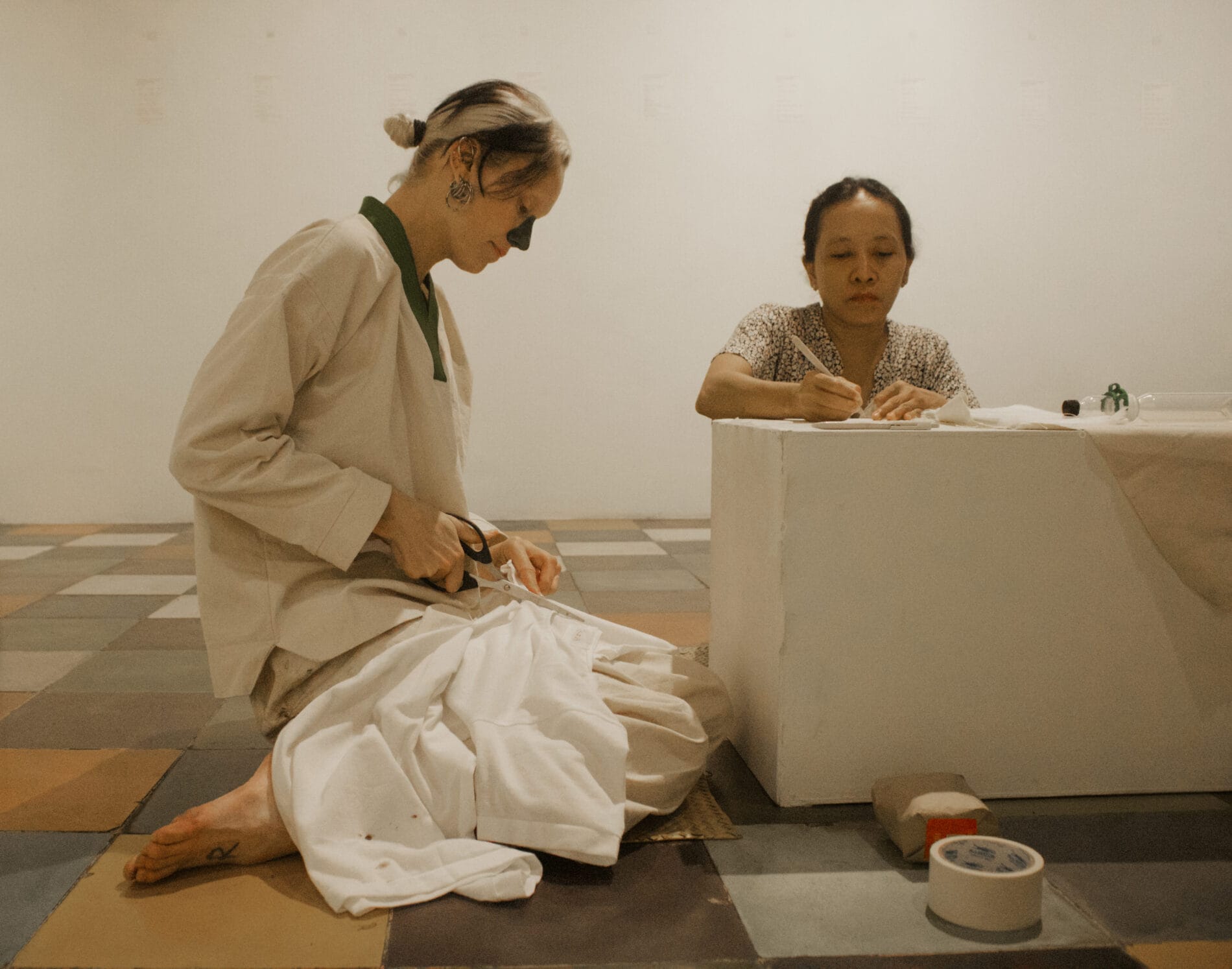


COLLECTIVE TEXTILE WORK
In this research artist Lisette Ros collects body odor as a material and artifact. She calls this an ‘odor print’: the unique biological scent akin to a fingerprint that every body carries. That scent is stored in worn clothing, among other things. This makes textiles an archive of people, memories and cultural history.
What you see above and below are remnants of T-shirts worn by Indonesian people in Yogyakarta, Indonesia, and community members in the Netherlands (Dutch-Indo, Indonesian, Moluccan). Lisette invited participants to wear a new white t-shirt for at least 24 hours straight. Including while sleeping, without washing and without using perfumes or deodorant.
Cross-stitch embroidery was introduced to the former Dutch East Indies during the colonial period and was often passed down from generation to generation. Lisette learned the technique from her great-aunt Bettie, born in Sumatra and raised in the Japanese internment camps on Java.
This landscape is unfinished, the process is the work.


© Photos by Eva Broekema, Lisette Ros, Panji
© Lisette Ros